
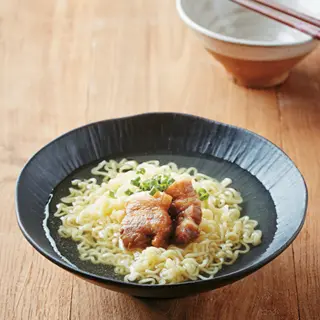
Photo: Korea Ministry of Food and Drug Safety
 South Korea
Pork Belly Ramyeon (Samgyeopsal Ramyeon)
삼겹살라면
Main dish · Boiled
MainsCourse
525kcal · per serving
Not spicySpice
Recipe
Pork Belly Ramyeon (Samgyeopsal Ramyeon)
Not spicyContains: gluten, soy
Ingredients Tap an ingredient to check it off
Servings1
- ramyeon noodles라면(100g)100 g
- thin green onion (jjokpa)쪽파(3g)3 g
- Broth: pork (belly,육수 돼지고기(삼겹살,(belly, 60g)60 g
- green onion대파(20g)20 g
- thinly sliced ginger얇게 썬 생강(5g)5 g
- bonito flakes가다랑어포(3g)3 g
- Braising sauce: low-sodium soy sauce조림양념 저염간장(3g)3 g
- cooking rice wine (maetsul)맛술(8g)8 g
- brown sugar흑설탕(3g)3 g
Nutrition per serving
525kcal
14.66gCarbs
3.25gProtein
2.97gFat
332.7mgSodium
Steps
Translated from the Korean original. Amounts are as in the original recipe.
- Rinse the pork in cold water, put it in a pot with water (300g), green onion and ginger and boil, and when the pork is cooked, strain through a cotton cloth.
- Boil water (300g) in a pot, add the bonito flakes and boil for 1 minute, turn off the heat, and when the bonito flakes sink, strain through a cotton cloth. Add water (300g) again, put in the bonito flakes strained through the cloth, boil over low heat for 10 minutes, and when the flakes sink, strain through a cotton cloth.
- Mix the pork broth and bonito flake broth, set aside 200g, add the braising sauce and boil, then add the pork and simmer.
- Boil the ramyeon noodles, rinse in cold water, and drain, and thinly slice the thin green onion.
- Bring the broth to a hot boil, put it in a bowl with the ramyeon noodles, top with the braised pork and thin green onion, and finish by pouring the remaining braising sauce from the pan over it.
💡 TipA bonito flake broth is used to reduce sodium intake. The ramyeon noodles are also rinsed in cold water after boiling to lower the sodium content.
Diet and allergy labels are estimated from the ingredient list. Check labels if you have an allergy.
Recipe source: Korea Ministry of Food and Drug Safety (MFDS) recipe database. English translation by WorldFoodPedia, not by MFDS.
Community recipes
No community recipes yet.
Sign in to share recipes, rate and comment.
Share your recipe for Pork Belly Ramyeon (Samgyeopsal Ramyeon)
More dishes from South Korea
View all Recipe
BibimbapKorean rice bowl dish
 Recipe
BulgogiMarinated, grilled Korean beef dish
 Recipe
GimbapKorean seaweed roll
 Recipe
KimchiTraditional Korean dish of fermented vegetables
 Recipe
TteokbokkiSouth Korean dish made from rice and flour cakes
 Recipe
NaengmyeonKorean dish of cold noodles
 Recipe
GalbiGrilled beef or pork ribs in Korean cuisine
 Recipe
JapchaeKorean dish of stir-fried glass noodles and vegetables