

 South Korea

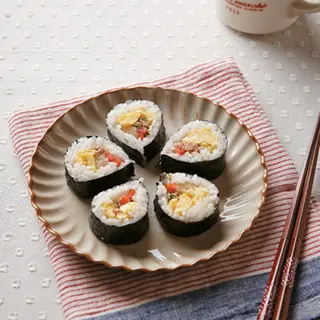
Gimbap
김밥
Korean seaweed roll
About this dish
Gimbap, also romanized as kimbap, is a Korean dish made from bap (cooked rice), vegetables, and optionally, cooked seafood or meat rolled in gim—dried sheets of seaweed—and served in bite-sized slices. Reference works describe gimbap as developing from Japanese norimaki, introduced to Korea during the period of Japanese colonial rule, while also noting that Korea had earlier traditions of wrapping rice and side dishes in seaweed, such as bokssam, from the Joseon era, which are sometimes cited as precursors rather than direct equivalents. However, the style of rolling seaweed into a ball on bamboo mat and cutting it to eat is generally agreed to have originated in Japan.
Description: Wikipedia — Gimbap, CC BY-SA 4.0
Sprout and Tuna Kimbap
Ingredients Tap an ingredient to check it off
- bell pepper파프리카(15g)15 g
- pineapple파인애플(15g)15 g
- egg달걀(30g)30 g
- gim (roasted seaweed)김(2g)2 g
- cooked rice밥(150g)150 g
- sprouts새싹채소(10g)10 g
- tuna참치(12g)12 g
- Sauce: low-sodium soy sauce소스 저염간장(5g)5 g
- mayonnaise마요네즈(2.5g)2.5 g
- sugar설탕(0.5g)0.5 g
Nutrition per serving
Steps
Translated from the Korean original. Amounts are as in the original recipe.
- Make the sauce.
- Cut the bell pepper and pineapple into bite-size pieces.
- Make scrambled eggs.
- Place a gim sheet cut to 2/3 size on a bamboo mat, spread the rice evenly, then add the sprouts, scrambled egg, bell pepper, oil-drained tuna and pineapple, and drizzle the sauce evenly.
- Fold it in half and cut into bite-size pieces to finish.
Diet and allergy labels are estimated from the ingredient list. Check labels if you have an allergy.
Recipe source: Korea Ministry of Food and Drug Safety (MFDS) recipe database. English translation by WorldFoodPedia, not by MFDS.
Community recipes
No community recipes yet.
Sign in to share recipes, rate and comment.
Share your recipe for Gimbap
More dishes from South Korea
View all Recipe
 Recipe
 Recipe
 Recipe
 Recipe
 Recipe
 Recipe
 Recipe