
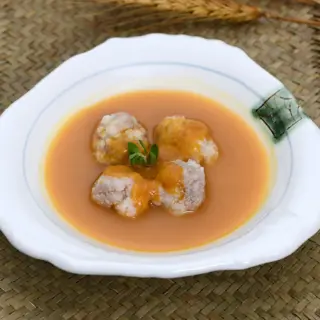
Photo: Korea Ministry of Food and Drug Safety
 South Korea
Kabocha Squash Doenjang Mash with Seafood Rolled Dumplings
단호박 된장매쉬와 해물굴림만두
Main dish · Steamed
MainsCourse
97kcal · per serving
Not spicySpice
No porkGluten-free
Recipe
Kabocha Squash Doenjang Mash with Seafood Rolled Dumplings
Not spicyNo porkGluten-freeContains: egg, soy, shellfish
Ingredients Tap an ingredient to check it off
Servings1
Shopping in
- beef소고기(우둔살,(round, 50g)50 g
- shrimp새우(3 whole)
- white fish흰살생선(100g)100 g
- kabocha squash단호박(1/2 pc)
- sweet potato고구마(50g)50 g
- starch녹말(10g)10 g
- egg달걀(1 pc)
- doenjang (soybean paste)된장(30g)30 g↔ No doenjang (soybean paste)? Use red or brown miso. Miso is sweeter and milder, so add a little more and a pinch of salt.🛒 Where to buy: Korean grocery stores; miso is in most supermarkets
- salt소금(0.1g)0.1 g
Nutrition per serving
97kcal
10.2gCarbs
11.3gProtein
1.2gFat
414.6mgSodium
Steps
Translated from the Korean original. Amounts are as in the original recipe.
- Steam the shrimp, white fish, and beef round, then let them cool slightly.
- Finely mince the steamed shrimp, white fish, and beef round.
- Add the starch and egg wash to the ? along with a little salt, mix evenly, and let it rest.
- Steam the sweet potato and kabocha squash in a steamer.
- Blend the steamed sweet potato and kabocha squash finely and mix in the doenjang.
- Shape the rested mixture into seafood meatballs, and add the meatballs while heating the doenjang-mixed kabocha squash and sweet potato.
💡 TipMixing sweet potato and kabocha squash into doenjang reduces sodium and makes a mild doenjang sauce with less saltiness.
Diet and allergy labels are estimated from the ingredient list. Check labels if you have an allergy.
Recipe source: Korea Ministry of Food and Drug Safety (MFDS) recipe database. English translation by WorldFoodPedia, not by MFDS.
Community recipes
No community recipes yet.
Sign in to share recipes, rate and comment.
Share your recipe for Kabocha Squash Doenjang Mash with Seafood Rolled Dumplings
More dishes from South Korea
View all Recipe
BibimbapKorean rice bowl dish
 Recipe
BulgogiMarinated, grilled Korean beef dish
 Recipe
GimbapKorean seaweed roll
 Recipe
KimchiTraditional Korean dish of fermented vegetables
 Recipe
TteokbokkiSouth Korean dish made from rice and flour cakes
 Recipe
NaengmyeonKorean dish of cold noodles
 Recipe
GalbiGrilled beef or pork ribs in Korean cuisine
 Recipe
JapchaeKorean dish of stir-fried glass noodles and vegetables