

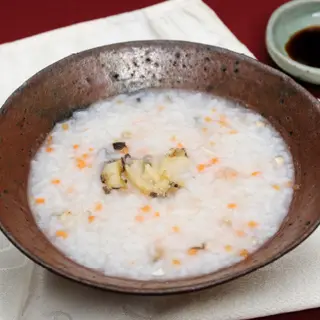
Photo: by linlilian at Flickr, CC BY 2.0, Wikimedia Commons
 South Korea

Jeonbok-juk
전복죽
Korean abalone rice porridge
About this dish
Juk is a Korean porridge dish that is made by boiling rice or other grains or legumes, such as beans, sesame, nuts, and pumpkin. Juk is often eaten warm, especially as a morning meal, but can also be eaten at any time of the day. Depending on the ingredients and consistency, juk can be considered as food for recuperation, a delicacy, or famine food. It is known to have nutritional benefits, and is considered to be beneficial to digestion because of its soft texture. It is a staple "get well" dish; a dish to eat when one is sick or recovering from bad health. Juk is also considered an ideal food for babies, the ill or elderly, as it is easily eaten and digested. It is also sold commercially by many chain stores in South Korea, and is a common takeout dish.
Description: Wikipedia — Jeonbok-juk, CC BY-SA 4.0
Abalone Porridge (Jeonbok Juk)
Ingredients Tap an ingredient to check it off
- rice쌀(50g)50 g
- abalone전복(50g)50 g
- shelled shrimp새우살(20g)20 g
- button mushrooms양송이(20g)20 g
- carrot당근(10g)10 g
- sesame oil참기름(10g)10 g
- pine nuts잣(10g)10 g
- Sauce: low-sodium soy sauce소스 : 저염간장(5g)5 g
Nutrition per serving
Steps
Translated from the Korean original. Amounts are as in the original recipe.
- Wash the rice clean, add about twice as much water, and soak thoroughly for about 30 minutes.
- Remove the abalone from the shells with a spoon and separate the innards.
- Wash the abalone with the innards removed and cut it up.
- Remove the tails from the shrimp and cut into small pieces.
- Peel the button mushrooms and cut into small pieces, and cut the carrot to match the size of the mushrooms.
- Add sesame oil to a pot, gently stir-fry the abalone, add the soaked rice and stir-fry, then add water and boil for about 20 minutes. When the porridge boils, add the shrimp, button mushrooms, and carrot and boil for about 20 more minutes, stirring gently. When the porridge comes together, top with pine nuts and serve with low-sodium soy sauce on the side.
Diet and allergy labels are estimated from the ingredient list. Check labels if you have an allergy.
Recipe source: Korea Ministry of Food and Drug Safety (MFDS) recipe database. English translation by WorldFoodPedia, not by MFDS.
Community recipes
No community recipes yet.
Sign in to share recipes, rate and comment.
Share your recipe for Jeonbok-juk
More dishes from South Korea
View all Recipe
 Recipe
 Recipe
 Recipe
 Recipe
 Recipe
 Recipe
 Recipe