
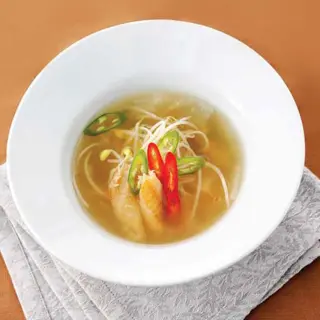
Photo: Korea Ministry of Food and Drug Safety
 South Korea
Hwangtae Hangover Soup Seasoned with Low-Sodium Doenjang (Hwangtae Haejangguk)
저염 된장으로 맛을 낸 황태해장국
Soup & stew · Boiled
Soups & stewsCourse
100kcal · per serving
3/5Spice
No porkGluten-free
Recipe
Hwangtae Hangover Soup Seasoned with Low-Sodium Doenjang (Hwangtae Haejangguk)
🌶 Spicy 3/5No porkNo meat or alcoholGluten-freeContains: soy, fish
Ingredients Tap an ingredient to check it off
Servings1
Shopping in
Hwangtae hangover soup
- shredded dried yellow pollack (hwangtae-chae)황태(채)(as needed)15 g
- soybean sprouts콩나물(1/6 pack)30 g
- Korean radish무(5×3×2cm)30 g↔ No Korean radish? Daikon is the closest. Turnip works in soups.🛒 Where to buy: Daikon is in many supermarkets and all Asian grocery stores
- low-sodium doenjang (soybean paste)저염된장(2 tsp)10 g↔ No low-sodium doenjang (soybean paste)? Use red or brown miso. Miso is sweeter and milder, so add a little more and a pinch of salt.🛒 Where to buy: Korean grocery stores; miso is in most supermarkets
- water물(1½ cups)300 ml
- cheongyang chili pepper (Korean hot green chili)청양고추(1/2 pc)5 g
- minced garlic다진 마늘(1/3 tsp)2 g
Nutrition per serving
100kcal
12gCarbs
13gProtein
0gFat
361mgSodium
Steps
Translated from the Korean original. Amounts are as in the original recipe.
- Clean the dried pollack, rinse it in water and drain. Trim and wash the soybean sprouts, and slice the cheongyang chili pepper on the diagonal.
- Pour water into a pot, add the dried pollack and radish and boil, then remove the solids from the broth and dissolve the low-sodium doenjang in it.
- Add the soybean sprouts, minced garlic and cheongyang chili pepper, cover with the lid, and boil until steam rises.
💡 TipUsing low-sodium doenjang instead of salt when cooking hwangtae hangover soup gives a less salty soup with deep savory flavor. Good hwangtae is yellowish in color with tender flesh. Store it in the freezer, or tightly sealed in a dry, cool place.
Diet and allergy labels are estimated from the ingredient list. Check labels if you have an allergy.
Recipe source: Korea Ministry of Food and Drug Safety (MFDS) recipe database. English translation by WorldFoodPedia, not by MFDS.
Community recipes
No community recipes yet.
Sign in to share recipes, rate and comment.
Share your recipe for Hwangtae Hangover Soup Seasoned with Low-Sodium Doenjang (Hwangtae Haejangguk)
More dishes from South Korea
View all Recipe
BibimbapKorean rice bowl dish
 Recipe
BulgogiMarinated, grilled Korean beef dish
 Recipe
GimbapKorean seaweed roll
 Recipe
KimchiTraditional Korean dish of fermented vegetables
 Recipe
TteokbokkiSouth Korean dish made from rice and flour cakes
 Recipe
NaengmyeonKorean dish of cold noodles
 Recipe
GalbiGrilled beef or pork ribs in Korean cuisine
 Recipe
JapchaeKorean dish of stir-fried glass noodles and vegetables