
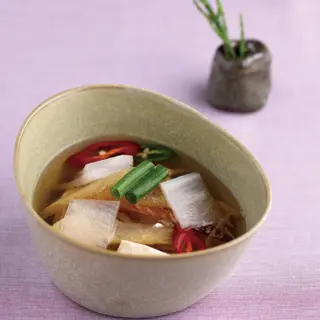
Photo: Korea Ministry of Food and Drug Safety
 South Korea
Dried Pollack, Tofu and Radish Soup (Hwangtae Dubu Mu-guk)
황태두부무국
Soup & stew · Boiled
Soups & stewsCourse
54kcal · per serving
2/5Spice
No pork
Recipe
Dried Pollack, Tofu and Radish Soup (Hwangtae Dubu Mu-guk)
🌶 Spicy 2/5No porkNo meat or alcoholContains: gluten, soy, fish
Ingredients Tap an ingredient to check it off
Servings1
Shopping in
- dried yellow pollack (hwangtae)황태30 g
- tofu두부50 g
- glasswort (hamcho)함초25 g
- Korean radish무100 g↔ No Korean radish? Daikon is the closest. Turnip works in soups.🛒 Where to buy: Daikon is in many supermarkets and all Asian grocery stores
- green chili pepper청고추20 g
- red chili pepper홍고추15 g
- thin green onion (jjokpa)쪽파10 g
- white pepper흰후추1 g
- fish sauce (eo-ganjang)어간장7 g
- green onion roots대파뿌리7 g
Nutrition per serving
54kcal
1gCarbs
7.7gProtein
2.1gFat
298.5mgSodium
Steps
Translated from the Korean original. Amounts are as in the original recipe.
- Cut the tofu into 1cm cubes, and cut half of the radish into thin squares and use the other half for the broth.
- Cut the tofu into 1cm cubes, and cut half of the radish into thin squares and use the other half for the broth.
- Cut the dried pollack into bite-size pieces.
- Make the broth with the dried pollack, green onion roots, glasswort and radish.
- Remove the glasswort and green onion roots from the finished broth and season with the fish sauce. Cut the radish left over from making the broth into thin squares and add it to the soup.
- Finally, add the tofu and boil, and finish by topping with the green and red chili peppers and thin green onion just before eating.
💡 TipThe flavor of the dried pollack itself gives taste and richness to the dish even without salt. The dried pollack broth boosts savory depth, and fish sauce, which is lower in saltiness than soup soy sauce, is used to reduce sodium.
Diet and allergy labels are estimated from the ingredient list. Check labels if you have an allergy.
Recipe source: Korea Ministry of Food and Drug Safety (MFDS) recipe database. English translation by WorldFoodPedia, not by MFDS.
Community recipes
No community recipes yet.
Sign in to share recipes, rate and comment.
Share your recipe for Dried Pollack, Tofu and Radish Soup (Hwangtae Dubu Mu-guk)
More dishes from South Korea
View all Recipe
BibimbapKorean rice bowl dish
 Recipe
BulgogiMarinated, grilled Korean beef dish
 Recipe
GimbapKorean seaweed roll
 Recipe
KimchiTraditional Korean dish of fermented vegetables
 Recipe
TteokbokkiSouth Korean dish made from rice and flour cakes
 Recipe
NaengmyeonKorean dish of cold noodles
 Recipe
GalbiGrilled beef or pork ribs in Korean cuisine
 Recipe
JapchaeKorean dish of stir-fried glass noodles and vegetables